Showing posts with label Bluetooth 5. Show all posts

Tuesday, May 7, 2019

nRF52840 v.2 - What's new?

From IC Revision 1 to 2

While there are quite a few changes available for review in the nRF52840 documentation, there is update that is particularly important for many users out there, including a large amount of our own customers. The update I am talking about is about the power supply.

First things first - if you're interested in reading the whole documentation for Nordic Semiconductor's nRF52840, then look no further than their Infocenter.

Wednesday, March 27, 2019

Burn your firmware - onto MDBT50Q-RX, that is.

Hi there, folks!

Here introduce the hardware setting perspective to burn your firmware onto MDBT50Q-RX Dongle.

(if you are looking for firmware coding setting, please visit "Firmware Coding & DFU onto MDBT50Q-RX")

So you have hopefully downloaded your IDE, you have written your code which you then plan to copy it over onto your MDBT50Q-RX and make it execute your master plan to take over the world!
Seriously, don't underestimate the Nordic nRF52840 based MDBT50Q-RX. USB sticks with Bluetooth can do wonders ;)
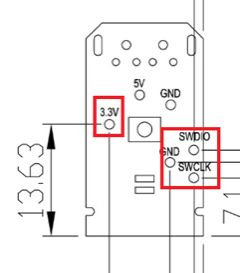
So, first of all, in order to be able to burn your code onto the USB Dongle, you will have to know the nerdy parts which includes which pins you will have to connect to. In our very well documented specification sheet for MDBT50Q-RX on section 8 which is called "Reference Circuit", you will find parts down to the left that has "3.3V/SWDIO/SWCLK/GND" marks on it:


Further down in the specification sheet, in section 9, you will find pictures illustrating where exactly on the PCB you can find these pins:
Pin locations

Now we know what to look for and where they are, so now we have only got to tell you how to use them.

Some people might not know this, but for developing these things, you need to get something called J-Link to connect your MDBT50Q-RX to your desktop. However, since this J-Link, when buying the official one from SEGGER, is very expensive, we strongly recommend you to just buy the nRF52840-DK from Nordic Semiconductor as it can be used as a J-Link through their software development kit (SDK) called nRFgo Studio and is MUCH CHEAPER than the official J-Link from SEGGER is.
Sidenote: There are a couple of other reasons why you should just get your hands on a nRF52840-DK from Nordic Semiconductor instead of getting a SEGGER J-Link, but that's not the topic of this post ;)

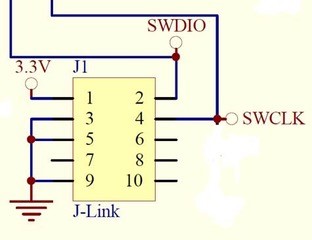
When this is done, this is finally how you connect your MDBT50Q-RX to your J-Link to make it all work:

MDBT50Q-RX and J-Link connection

Here you will have to pay attention to the fact that you have to connect J-Link pins 3, 5 & 9 to GND. Otherwise, you won't be able to burn anything onto your dear MDBT50Q-RX.
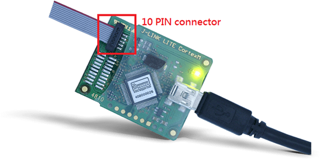
The physical connection should look like this:

J-Link Cable Connection

Pay attention to the direction of the cable, because that will also matter. The direction we mean in this case is which way the slim strip of red is facing.

As we have just revised our MDBT50Q-RX, our customers who have been developing firmware for our USB dongle should take a look at our previous blog post in which we explain about the changes made or contact us directly at service@raytac.com

Have a good day and we at Raytac wish you smooth and happy tinkering :)

Raytac Corporation 勁達國際電子有限公司
A BT5 & BT 4.2 & BTv4.1 module maker based on Nordic nRF51 & nRF52 solution
(nRF51822 & nRF51422 & nRF52832 & nRF52810 & nRF52840)

www.raytac.com email: cs@raytac.com Tel: +886.2.3234.0208

Wednesday, February 13, 2019

Raytac Corporation at IT Week Hall 3 & 4 / 11-22

With over 600 exhibitors gathering in Tokyo, Japan from April 10-12, IT Week has become one of  the biggest exhibitions within the IoT Technology sector.
Raytac is pleased to be attending this year's IT Week and present our full range of module family based on Nordic nRF51822, nRF52832 and nRF52840.

Meanwhile, the latest product, MDBT50Q-RX, a multi protocol nRF52840 dongle will make its second public appearance which powers up the most advanced IoT and Mesh network implementations.

Friday, January 25, 2019

MDBT50Q-RX, a nRF52840 USB Dongle, delivers an easy implement for M2M IoT application

Raytac’s BT5 certified nRF52840 USB dongle, MDBT50Q-RX, eliminating the need for RF design expertise, and speeding time to market for complex M2M IoT applications. The Dongle built by Raytac's MDBT50Q-P1M module with FCC/IC/CE/Telec/KC/SRRC/NCC/RCM/WPC certification.

Thursday, January 10, 2019

Bluetooth - Current and soon-to-perish versions

Bluetooth has been around for quite some time, but that doesn't mean that no one is a beginner when it comes to developing Bluetooth-based products. In fact, due to their recent updates, Bluetooth is becoming increasingly popular as demand for power efficient gadgets and wireless technology is increasing. Smart watches is just one of the many examples out there.

For each and every single one of these devices, you'll first have to register your new product with Bluetooth-functions built in on Bluetooth SIG's website. You will eventually register (and pay for) your product based on what version of the Bluetooth protocol that you're using in the product and do so by purchasing a so called Declaration ID (DID).

Yes, a little exaggeration in the title, but that's essentially what it comes down to. Bluetooth SIG is doing some major updates and changes to the Bluetooth protocol which includes getting rid of the more outdated versions.

There are quite a few versions of the Bluetooth protocol out there, but nowadays you will basically be advised to choose from 2 versions:
v.4.2 or v.5.0
These two versions would be, as I mentioned in the title, the two current versions of Bluetooth.

Although it might seem very simple at first, there are a few things that you need to understand the content of the announcements to fully grasp what these updates and changes mean. That, my friends, is today's topic of this post.


Archived specifications

Deprecated and Withdrawn Specifications
When a specification reaches the end of its useful life, the Bluetooth® SIG may choose either to deprecate the specification, ending maintenance and restricting its use, or to withdraw the specification from use.
Bluetooth SIG - https://www.bluetooth.com/specifications/archived-specifications

What has changed recently is nothing new, but it's big. What I mean is that similar changes have been done in the past, but since the market is more dependent on the technology now than before, it matters far more for people when the Bluetooth SIG do the same changes nowadays. Those changes are as follows:

On 01/28/2019, the following policy changes will be enacted: 
- Creating new designs that implement deprecated or withdrawn specifications will not be permitted 
- New products cannot be added to designs that implement withdrawn specifications 
- You cannot pay a $25,000 fee to qualify a new design that implements a deprecated specification 
- Purchased but unused $25,000 Declaration IDs will no longer be valid and the cost of any unused $25,000 Declaration IDs will be credited to your account 
 Bluetooth SIG - bluetooth.com

This piece of information tells us that the process of withdrawing specifications comes down to two different steps, namely deprecation and withdrawal.
While deprecation literally means "to stop use", it is in this case the first step in the process of making a certain Bluetooth specification obsolete.
Then there's a time gap between a certain specification gets deprecated until it's withdrawn. During this gap, as mentioned above, no new designs can be paid for and/or registered and unused DID's will be invalid. This is only to prevent new devices with deprecated Bluetooth specifications from being produced. To stop the "bloodline" of those specifications if you will. During this gap, however, you are still able to add new products that implement the same fundamental design (e.g. version updates) as you wish.

After this gap is over, when the specification in question is actually withdrawn, you will not be able to add any new products to any existing designs.

Got it? No? It's alright. In fact, there's a lot of information and it's hard to put into context right away. Just to make things clear, let's make an example:
Company R is currently developing a new device called RIC which implements Bluetooth 4.0 specifications. For now, everything's alright and Company R can go right ahead with their developments.
When the Bluetooth core specification 4.0 becomes deprecated in Jan 28th, Company R can no longer come up with new product designs such as RIC-2 since that would count as a new design, but Company R can update their original device RIC as long as they don't change the physical design.
Then, when the Bluetooth core specification 4.0 is finally withdrawn, Company R cannot update their product RIC anymore AND they cannot register new designs under Bluetooth core specification 4.0.

If you're a developer who is very familiar with Bluetooth already, this information might already be, as certain people refer it as, "peanuts". If you're new to the Bluetooth world, however, this is a lot to take in and you might want to read up more about it. We hope this explanation made things clearer for you though :)

You can find more info at:
Bluetooth SIG - https://www.bluetooth.com/specifications/archived-specifications


Don't forget that Raytac Corporation's modules are all pre-certified with FCC, TELEC, IC, CE, RCM, KC and SRRC. The best part is that more is yet to come!
Take a look at our modules on our website: www.raytac.com


Raytac Corporation 勁達國際電子有限公司
A BT5 & BT4.2 & BT4.1 module maker based on Nordic nRF51 & nRF52 solution 
(nRF51822 & nRF51422 & nRF52832 & nRF52810 & nRF52840)

www.raytac.com          email: cs@raytac.com          Tel: +886.2.3234.0208

Monday, August 21, 2017

Tuesday, August 1, 2017

What is the difference about Nordic nRF52 Solution for BT5

Nordic Semiconductor released several nRF52 series SoC for BT5.
What is the difference between those solutions? How to select the idea one? 
Here is a simple comparison chart provided for developers quick reference.

Monday, June 26, 2017

Raytac MDBT42Q Series Module built by Nordic nRF52810 Solution


Raytac built up module based on nRF52810
Chip Antenna Version Part No. : MDBT42Q-192K
PCB Antenna Version Part No. : MDBT42Q-P192K

Dimension:  16 x 10 x 2.2 mm
Certification Granted: FCC / IC / CE / Telec / KC / SRRC / NCC
Module expected to start shipment by 2017/10


Friday, March 31, 2017

Guess What? Raytac is ready for nRF52840


Raytac now is ready for coming nRF52840 SoC with Bluetooth specification BT5.

The module’s mass production schedule will be ascertained after Nordic IC supplying schedule affirmed. (expected around 2017 Q4 or 2018 Q1)


Friday, December 23, 2016

Nordic nRF52840 Overview

Raytac Corporation 

Bluetooth module maker based on Nordic nRF51 & nRF52 solution 
(Nordic nRF51822 & nRF51422 & nRF52832 & nRF52840)
Bluetooth Specification Version: BT4.0 & BT4.1 & BT4.2
Tel: +886.2.3234.0208
email: service@raytac.com
https://raytacblog.wordpress.com/

Quoted from Nordic


nRF52840

Advanced Multi-protocol SoC supporting Bluetooth 5 / ANT /802.15.4 / 2.4GHz Proprietary Acitve

The nRF52840 SoC is an advanced, highly flexible ultra-low power multiprotocol SoC ideally suited for ultra low-power wireless applications. The nRF52840 SoC is built around a 32-bit ARM® Cortex™-M4F CPU with 1MB flash and 256kB RAM on chip. The embedded 2.4GHz transceiver supports Bluetooth® low energy (Bluetooth 5), 802.15.4, ANT and proprietary 2.4GHz protocols. It is on air compatible with existing nRF52 Series, nRF51 Series, and nRF24 Series products from Nordic Semiconductor.


Bluetooth 5
The nRF52840 has hardware support on-chip for Bluetooth 5. This includes long range and high throughput capability. It supports all Bluetooth low energy physical layer bit rates and modulation schemes.

Processing Power
The nRF52840 incorporates a powerful Cortex-M4F processor running at 64 MHz enabling the most demanding applications with complex arithmetic requirements to be realized in a single chip solution. This CPU configuration supports DSP instructions, HW accelerated Floating Point Unit (FPU) calculations, single-cycle multiply and accumulate, and hardware divide for energy-efficient processing complex operations.
Multiprotocol Radio
The 2.4GHz radio supports multiple protocols including Bluetooth low energy, ANT, 802.15.4 and 2.4GHz proprietary. It supports Bluetooth low energy 2Mbs and 1Mbs and Bluetooth 5 long range (500kbs and 125kbs). The radio supports high resolution RSSI measurement and automated functions to reduce CPU load, including EasyDMA for direct memory access for packet data and assembly. Nordic provides protocol stacks for Bluetooth low energy. ANT protocol stacks are available from ANT.

Memory to expand
The nRF52840 has extensive on-chip memory in both flash (1MB) and RAM (256kB) offering powerful possibilities for today’s advanced wireless applications.

Power Efficiency
The nRF52840 SoC employs power and resource management to maximize application energy efficiency and battery life. The supply range between 1.7V and 5.5V supports primary and secondary cell battery technologies and direct USB supply without the need for external regulators. All peripherals have independent and automated clock and power management to ensure they are powered down when not required for task operation to keep power consumption to a minimum without the application having to implement and test complex power management schemes.The nRF52840 has a comprehensive system of automated and adaptive power management features. These features are built into all aspects of device operation from power supply switching, to peripheral bus/EasyDMA memory management, and automated shut down of all but the absolute essential peripherals required to perform a task.

ARM® TrustZone® Cryptocell-310
ARM Cryptocell-310 is a powerful on-chip cryptographic co-processor providing cryptographic functions and services to speed up operations significantly, save CPU processing time and reduce energy consumption. It incorporates a true random number generator (TRNG) and support for a wide range of asymmetric, symmetric and hashing cryptographic services for secure applications.
On-Chip NFC Tag
NFC™-A tag support is included on chip. NFC Type 2 and Type 4 tag emulation protocol stacks are provided by Nordic opening up a range of new applications, like NFC payment, and improved user experience for existing BLE applications with Out-of-Band (OOB) pairing. OOB pairing using NFC simplifies the process of authenticated pairing between two Bluetooth devices by exchanging authentication information over an NFC link.

USB 2.0
The nRF52840 has on-chip USB 2.0 (Full speed) support and on-chip VBUS regulation allowing for direct connection to USB hosts for data transfer and direct USB power for hosted applications.

Package Options
The nRF52840 is available in 7x7mm 73pin AQFN package with 48 available GPIO.

SoftDevices
The Nordic protocol stacks are known as SoftDevices. The nRF52840 is supported by the S140 SoftDevice. The S140 SoftDevice is a Bluetooth 5 pre-qualified Bluetooth low energy protocol stack.

More information on the nRF52840 can be found on Nordic's Infocenter

FEATURES

  • Advanced Single chip 2.4 GHz multi-protocol SoC
  • 32-bit ARM Cortex-M4F Processor
  • 1.7v to 5.5v operation
  • 1MB flash + 256kB RAM
  • Bluetooth 5 support for long range and high throughput
  • 802.15.4 radio support
  • On-chip NFC
  • PPI –Programmable Peripheral Interconnect
  • Automated power management system with automatic power management of each peripheral
  • Configurable I/O mapping for analog and digital I/O
  • 48 x GPIO
  • 1 x QSPI
  • 4 x Master/Slave SPI
  • 2 x Two-wire interface (I²C)
  • I²S interface
  • 2 x UART
  • 4 x PWM
  • USB 2.0 controller
  • ARM TrustZone CryptoCell-310 Cryptographic and security module
  • AES 128-bit ECB/CCM/AAR hardware accelerator
  • Digital microphone interface (PDM)
  • Quadrature decoder
  • 12-bit ADC
  • Low power comparator
  • On-chip 50Ω balun
  • On-air compatible with nRF52, nRF51 and nRF24 Series

APPLICATIONS

  • Advanced high performance wearables
  • Wearables for secure payments
  • Virtual Reality/Augmented Reality systems
  • Smart Home sensor networks
  • Smart city sensor networks
  • High performance HID controllers
  • Internet of Things (IoT) sensor networks
  • Smart door locks
  • Smart lighting networks
  • Connected white goods


Wednesday, October 5, 2016

Nordic nRF5 SDK v.12.1.0 Released

Raytac Corporation
A BT4.1 & BT4.2 module maker based on Nordic nRF51 & nRF52 solution 
(nRF51822 & nRF51422 & nRF52832 & nRF51802)
Tel: +886.2.3234.0208
email: service@raytac.com  
 https://raytacblog.wordpress.com/


Nordic relleased nRF5 SDK V12.1.0

Software Update


nRF5 SDK v.12.1.0
Software Development Kit for the nRF51 Series and nRF52 Series.
Highlights of this release:
  • Added serialization of the S132 SoftDevice v3.0.0. Serialization of S130 is now deprecated.
  • Included the latest MDK v8.9.0 with a crucial workaround for nRF52832 Errata 108.
More information in the release notes (inside the download).

Saturday, September 10, 2016

Raytac's Welcome Indian Partner Atoll Solutions Join the Module Selling

Raytac Corporation
A BT4.1 & BT4.2 module maker based on Nordic nRF51 & nRF52 solution 
(nRF51822 & nRF51422 & nRF52832 & nRF51802)
Tel: +886.2.3234.0208
email: service@raytac.com  
 https://raytacblog.wordpress.com/

Atoll Solutions Pvt Ltd.,
#229, 2nd Floor, 2A Main, 5th Cross,
New Thippasandra, HAL 3rd Stage,
Bangalore - 560 075
India


Description BlueBee:

Atoll BlueBee evaluation board is targeted at customers looking build products
with Nordic Semiconductor’s nRF52 BT4.2 chip. To ease of movement from
development to production, board is developed with Raytac Corporation’s MDBT42Q module.
Reaytac MDBT42Q module is certified for worldwide use.


Thursday, July 21, 2016

MDBT42Q Development Board Now Available

Raytac Corporation
A BT4.1 & BT4.2 module maker based on Nordic nRF51 & nRF52 solution 
(nRF51822 & nRF51422 & nRF52832 & nRF51802)
Tel: +886.2.3234.0208
email: service@raytac.com  
 https://raytacblog.wordpress.com/

MDBT42Q / MDBT42Q-P which are built based on Nordic nRF52832 solution.
The modules now are already in mass production stage for volume shipment.

Raytac would like to announce that MDBT42Q Series Development Board now is available.
Developers may access through Raytac's Distributors or direct to Raytac Corporation for inquiry.


Monday, June 20, 2016

About Bluetooth 5

Raytac Corporation
A BT4.1 & BT4.2 module maker based on Nordic nRF51 & nRF52 solution 
(nRF51822 & nRF51422 & nRF52832 & nRF51802)
Tel: +886.2.3234.0208
email: service@raytac.com  
 https://raytacblog.wordpress.com/


Simple Summary


Scheduled to be released in end or 2016 or early 2017


1.Quadruples range

Extending range will deliver robust, reliable Internet of Things (IoT) connections that make full-home and building and outdoor use cases a reality. The expect power consumption of BT5  is expected to remain the same level as BT4.2. 

BT4.2: 10~100M
BT5.X: Upto 400M


2.Doubles speed

Higher speeds will send data faster and optimize responsiveness. Increasing broadcast capacity will propel the next generation of “connectionless” services like beacons and location-relevant information and navigation.

BT4.2: 1M bit/Sec
BT5.X: 2M bit/Sec

3. Data broadcasting capacity by 800%

Bluetooth 5,will quadruple range and double speed of low energy connections while increasing the capacity of connectionless data broadcasts by 800%. 


According to SIG's news press
 “Increasing operation range will enable connections to IoT devices that extend far beyond the walls of a typical home, while increasing speed supports faster data transfers and software updates for devices. And now with the ability to broadcast a much richer set of information, Bluetooth 5 will make beacons, location awareness, and other connectionless services an even more relevant part of an effortless and seamless IoT experience” 

"With the major boost in broadcast messaging capacity, the data being transferred will be richer, more intelligent. This will redefine the way Bluetooth devices transmit information, moving away from the app-paired-to-device model to a connectionless IoT where there is less need to download an app or connect the app to a device."


To redefine the behavior of moving away from app-paired-to-device model must bring a revolutionary user behavior and environment from 2017. That is the most critical point for all product design or related Bluetooth industry need to pay highly attention!