Showing posts with label Bluetooth Smart. Show all posts

Friday, December 30, 2016

nRF52 BLE Module (MDBT42 series) BQB Test & BT4.2 Certification Granted

Raytac Corporation 

Bluetooth module maker based on Nordic nRF51 & nRF52 solution 
(Nordic nRF51822 & nRF51422 & nRF52832 & nRF52840)
Bluetooth Specification Version: BT4.0 & BT4.1 & BT4.2 & BT5
Tel: +886.2.3234.0208
email: service@raytac.com
We are pleased to release that Raytac's MDBT42 series module (including MDBT42Q / MDBT42 / MDBT42V) based on Nordic nRF52 series solution has completed the BQB testing and BT4.2 certificated granted.

Customers are welcome to use or relabel the QDID accordingly.

MDBT42 Module QDID: 91882 (Declaration ID: D033661)
MDBT42 Profile Subsystem QDID: 91659 (Declaration ID: D033662)


Thursday, December 15, 2016

Bluetooth Brand Guide Update

Raytac Corporation 

Bluetooth module maker based on Nordic nRF51 & nRF52 solution 
(Nordic nRF51822 & nRF51422 & nRF52832 & nRF52840)
Bluetooth Specification Version: BT4.0 & BT4.1 & BT4.2
Tel: +886.2.3234.0208
email: service@raytac.com
https://raytacblog.wordpress.com/

Bluetooth SIG Board of Directors approved an update to the Bluetooth® Brand Guide on 6 December 2016. 


Bluetooth SIG updated and modified the blue color used for the Bluetooth trademarks. In addition, the Bluetooth SIG will phase out all use of the Bluetooth Smart and Bluetooth Smart Ready marks in 2016

As such, SIG ask that all licensees 
(1) update their use of the Bluetooth trademarks to reflect the modified color blue, and 
(2) cease use of the Bluetooth Smart and Bluetooth Smart Ready marks on or before 1 January 2017 and revert to using the Bluetooth word mark, figure mark and/or combination mark, as appropriate. 

For detail of Bluetooth loge data, readers can visit SIG official website to get more THE Brand Guide information. 
The Brand Guide contains instructions for proper use of the Bluetooth trademarks. Please refer to the Brand Guide for word mark and logo usage information, including placement and color requirements and product naming conventions.


Wednesday, October 26, 2016

Raytac's nRF51 Module (MDBT40/MDBT40-P) Bluetooth QDID information


Raytac Corporation
Bluetooth module maker based on Nordic nRF51 & nRF52 solution 
((Nordic nRF51822 & nRF51422 & nRF52832)
Bluetooth Specification Version: BT4.0 & BT4.1 & BT4.2
Tel: +886.2.3234.0208
email: service@raytac.com  

Bluetooth products must purchase DID and submit the testing evidence issued by BQE to completed the SIG registration and activate the DID


Only products's DID been activated then allowed to use Bluetooth logo.

Developer's who built the products based on Raytac module is allow to relable Raytac's DID to easy the process.

Simply purchase their own DID from SIG, and relabel Raytac's DID then can completethe Bluetooth activation process.


Raytac's MDBT40/MDBT40-P QDID/DID is applied by subsidiary of Ginstar Corporation.
The QDID is 60912 / D023258

We welcome all Raytac's customers to relabel the QDID as long as product built by MDBT40/MDBT40-P. As such, the Bluetooth process becomes simple and cost effective.


Saturday, September 10, 2016

Raytac's Welcome Indian Partner Atoll Solutions Join the Module Selling

Raytac Corporation
A BT4.1 & BT4.2 module maker based on Nordic nRF51 & nRF52 solution 
(nRF51822 & nRF51422 & nRF52832 & nRF51802)
Tel: +886.2.3234.0208
email: service@raytac.com  
 https://raytacblog.wordpress.com/

Atoll Solutions Pvt Ltd.,
#229, 2nd Floor, 2A Main, 5th Cross,
New Thippasandra, HAL 3rd Stage,
Bangalore - 560 075
India


Description BlueBee:

Atoll BlueBee evaluation board is targeted at customers looking build products
with Nordic Semiconductor’s nRF52 BT4.2 chip. To ease of movement from
development to production, board is developed with Raytac Corporation’s MDBT42Q module.
Reaytac MDBT42Q module is certified for worldwide use.


Friday, July 29, 2016

Open source Bluetooth low energy beacon is so simple to program and debug almost anyone can do it wirelessly from a website with JavaScript

Raytac Corporation
A BT4.1 & BT4.2 module maker based on Nordic nRF51 & nRF52 solution 
(nRF51822 & nRF51422 & nRF52832 & nRF51802)
Tel: +886.2.3234.0208
email: service@raytac.com  
 https://raytacblog.wordpress.com/


This open source Bluetooth low energy beacon is like a development kit and finished product all in one small package that needs no wires or software

Entering its last week on Kickstarter for delivery in December (campaign ends Friday August 5 at 8pm GMT) the $30 Puck.js has all the required programing and debug software tools built-in, and runs from a single Nordic Semiconductor nRF52832 Bluetooth low energy System-on-Chip (SoC) with built-in ARM Cortex M4F processor
,


Nordic Semiconductor today announces the availability on Kickstarter of a Nordic nRF52832 SoC based Bluetooth® low energy (formerly Bluetooth Smart) beacon, named Puck.js, that is said to be so simple to program almost anyone can do it wirelessly from a website using a graphical editor or easy-to-learn JavaScript instead of C or C++ traditionally used by Bluetooth low energy beacon developers.

“Most manufacturers conveniently gloss over the difficulties of programming their hardware, and other beacons are provided without software or left crippled by their boring factory-installed firmware,” says UK-based Puck.js creator, Gordon Williams. “Puck.js is different. It comes with our Open Source JavaScript interpreter ‘Espruino’ pre-installed, which makes it incredibly easy-to-use and means you can get started in just seconds, without any prior programming experience.”

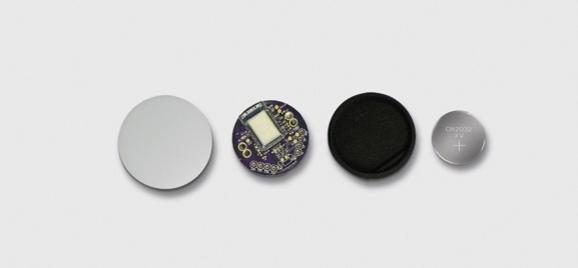
The intentionally hacker-friendly Puck.js is open source, supports both the iBeacon and Eddystone beacon formats, and will be supplied with firmware updates for the forthcoming Bluetooth v5.0 specification that will quadruple the range and double the speed of Bluetooth v4.2. Puck.js has a circular 35mm diameter form-factor that is 10mm thick, with a silicone rubber cover and plastic base. It is powered from a CR2032 coin cell battery and includes a magnetometer (digital compass), user-assignable tactile button, and four (Red, Green, Blue, and Infrared) LEDs.

Thanks to the Nordic Semiconductor nRF52832 SoC, the Puck.js benefits from an extremely powerful ARM® Cortex®-M4F processor, 64MHz clock speed, an extremely generous 64kB of RAM and 512kB of Flash, built-in Near-Field Comms (NFC™), Over-the-Air firmware updates, 12-bit ADC, timers, SPI, I2C, and serial interfaces that can be used on any available pins, plus a temperature sensor.

Williams says that in summary this means the Puck.js can measure rotation (e.g. using the Puck as a control knob), light, temperature, magnetic fields (e.g. magnets used on doors to detect opening and closing or water level via a magnet on a float), can control Infrared devices, and produce any color light.

“JavaScript is probably the most popular programming language at the moment and the majority of web developers, makers, and students at school wouldn’t usually have used C or C++,” Williams continues. “So what I aimed to do with Puck.js was lower the barrier-to-entry and make development easier and more fun – allowing a whole bunch of people to use Bluetooth low energy beacon and IoT technologies that may otherwise be restricted to professional embedded developers.”

Williams says Puck.js is like a development kit that’s also a finished product. “You insert a battery, put the case on, and it’s a ready-to-go Bluetooth low energy beacon straight-out-the-box with no wires of software required,” he adds. “At the same time it’s very easy to add new functions and features for home automation projects, IoT prototyping, or education purposes.”