Showing posts with label BQB. Show all posts

Wednesday, July 5, 2023

Important Notice:Upcoming price increase in Bluetooth SIG Membership Fees and DID

 The Bluetooth SIG Board of Directors(BoD) has granted its approval for a 15% increase in member fees, effective from January 1,2024. This decision comes after careful consideration of the organization's financial situation and the need to cover the rising costs of current and futrue member services throughout 2024.

Bluetooth

Feel free to explore the mission and operations of the Bluetooth SIG by visiting the provided web pages below:


Raytac Corporation 勁達國際電子有限公司
A Bluetooth & WiFi module maker based on Nordic nRF53, nRF52, nRF70 solution 
www.raytac.com email: service@raytac.com Tel: +886.2.3234.0208   

Wednesday, May 24, 2023

The “Must Know” about WPC-ETA certificate before entering Raytac Bluetooth module into India

 Intro:

You will get a brief understanding of WPC-ETA certificate (India) and how it relates to Raytac low energy Bluetooth module and how it helps you entering Raytac Bluetooth module into India by passing through importing and Customs clearance procedure way efficiently.

There are some types of ETA certificate categorized by the spec of your wireless transmission product (Bluetooth/Wifi/RFID and by device using frequency spectrum).

Hereafter we’re talking about the WPC-ETA compliance regulation to specifically on “Raytac’s low energy Bluetooth module.”


Outline of the article:

  1. What is WPC Certificate/Equipment Type Approval (ETA) in India?
  2. Raytac Bluetooth module applied to WPC-ETA Regulation Category
  3. What is essential to get the ETA-SD license (ETA Approval)?
  4. How the ETA-SD license works during importing process


A. What is WPC Certificate/Equipment Type Approval (ETA) in India?

The WPC (Wireless Planning & Coordination) is the broadcasting authority and is part of the Ministry of Communications and Information Technology in India.

Products with radio and/or wireless functionality imported or manufactured or marketed in India are required to have an Equipment Type Approval certificate (ETA certificate) from the Wireless Planning and Coordination (WPC India) Wing of the Ministry of Communications of the government of India. This includes product with Bluetooth, wireless local area network access technology (Wi-Fi), small digital radios (Zigbee), and radio frequency identification (RFID) and else more. The WPC-ETA certificate is required for anyone who wants to do wireless device business in India.


B. Raytac Bluetooth module applied to WPC-ETA Regulation Category

--ETA Through Self Declaration (ETA-SD License)

To specifically recognize what is the compliance regulation of equipment applies to Raytac Bluetooth module, we can be assured with our Bluetooth module spec located within “De-licensed Frequency Band list” , 2400-2483.5MHz / Limit with 10mW EIRP / Use of low power and very low power short range radio frequency device for Non-Specific Short range device, from the following chart which was released from WPC authority.

Once we confirm Raytac Bluetooth module spec is operated in De-License Frequency Band with low transmission power, at the mean time making sure the device is exempt from import license as per Import Policy of DGFT (Directorate General Of Foreign Trade), Ministry OM ETA-WPC-Policy-2018-19 dated 26th February 2019, free from EXIM Policy of DGFT, Raytac is granted to apply for “ETA Through Self-declaration” application procedure which was enabled by SARAL SANCHAR Portal of DoT on 12th April, 2019.

Here's Raytac’s ETA through self-declaration (ETA-SD license) of module MDBT50 certified by WPC authority. (Please refer to the following image)


C. What is essential to get the ETA-SD license (ETA Approval)?

After getting idea of what ETA-SD license means to Raytac low energy Bluetooth module business, we need to get ready of the following points for applying the ETA Approval (ETA-SD License)

  • Applicant must be India manufacturing or authorized Indian representative
  • Making sure product exempt from import license
  • Making sure product working in the de-licensed frequency band
  • Wireless RF test report conducted by accredited laboratory
  • Details of Accreditation laboratory & Accreditation certificate issuing authority
  • Authorization letter


D. How the ETA-SD license works during importing process

  1. Once ETA through self-declaration is generated for a model, subsequently it may be utilized by other person(s) for import/usage purpose in India. It is not necessary the importing agent/manufacturer is same party to the applicant of the license.
  2. Question: How to import products falling under the category of ETA through Self-Declaration?      Answer: Such category of product(s) may be imported by submitting an undertaking to the customs along with ETA-SD License without additional payment.
  3. The ETA-SD license remains valid and NO renewal is needed until the technical parameter/design of the device is modified or altered.
  4. Generally speaking , India doesn’t follow Modular policy nor Non-Modular policy. It determines how you proceed WPC-ETA certificate by product type (Semi-finished & End-product) and product technical spec (Frequency spectrum & Max output power).  For instance: When the product is manufactured in India and its RF module(s) having ETA certificate is/are fitted inside it without any modification/alteration; then NO separate ETA is required for such finished product during import process. However, if finished product(s) are manufactured outside India, then ETA is required for each product before its import.
  5. For the product which does not fall under De-Licensed frequency band and exempt from import license, WPC/ETA Certificate shall be obtained by routine proceeding to the concerned RLO ETA certificate. Both ETA (RLO) certificate and Import license shall be submitted to Customs during importing process whereas ETA-SD license Raytac module certified is exempt from import license that is way easier to proceed.

Edited by Account Manager: Jocelyn Tsai


Raytac Corporation 勁達國際電子有限公司
A Bluetooth & WiFi module maker based on Nordic nRF53, nRF52, nRF70 solution 
www.raytac.com email: service@raytac.com Tel: +886.2.3234.0208                             

Bluetooth Solution:  nRF5340, nRF52840, nRF52833, nRF52832, nRF52820, nRF52811, nRF52810, nRF52805, nRF51822                                                                                  WiFi Solution: nRF7002  


Tuesday, May 9, 2023

What’s New In BT5.4 Bluetooth Specification?

Bluetooth Core Specification 5.4 released in 2023 introduces four significant capabilities to the existing specifications.

1. Periodic Advertising with Response(PAwR)

PAwR is one of the key feature. Prior to Bluetooth 5.4, connectionless bidirectional communication is not possible. PAwR now allows bidirectional transfer of data in connectionless mode between a single central device and a large number of multiple devices (up to 32,640) in a star network topology. 

Periodic Advertising with Response(PAwR)

2. Encrypted Adverting Data (EAD)

EAD provides a standardized approach to the secure broadcasting of data in advertising packets and enables the encrypted data over-the-star network to be decrypted only by devices that have shared the key material previously. This security feature protects PAwR communications to safeguard against data tampering, human error, and data leaks.

Encrypted Adverting Data (EAD)

3. LE GATT Security Levels Characteristic(SLC)

When a GATT Client attempts to access a server attributes (characteristics, descriptors), attributes permissions are checked. If permissions are insufficient, the access is denied and all GATT features will not work properly. With SLC, the client can upgrade its security level to reattempt access of the previous failed operation. SLC enables devices to identify the security mode and level for all their GATT functionality.

4. Advertising Coding Selection

For LE Coded PHY, a Forward Error Correction (FEC) algorithm is used which results in significantly longer transmission distances. FEC parameter (S) uses one of two values (S=2 or S=8) and controls how much data is made to fix errors and how much Bluetooth range may be achieved. Prior to Bluetooth 5.4, specifying the value of the S coding parameter was not impossible. Bluetooth 5.4 allows the host to specify the value of the coding parameter S (S=2 or S=8) when the LE Coded PHY is selected for use with extended advertising.


Main beneficiary market of Bluetooth 5.4

The combination of these features enables ultra-low power, efficient radio usage and secure star networks that can be deployed in large scale ESL (Electronic Shelf Labels) and sensor applications with transferring a small amount of data. Devices accept slightly longer advertising-delay to exchange an extended battery life. It’s easy to see the retail industry as well as the market for ESL and shelf sensors will benefit greatly. ESL are devices that display pricing information for product on retail store shelves. They use small electronic paper displays powered by batteries and can replace traditional paper labels. Besides, ESL use wireless technology and a central hub device to transmit data, allowing retailers to automate pricing and replace traditional manual processes, and creating more efficient in-store operations.


Edited by Account Manager: Ms. Gracie Chuang

Raytac Corporation 勁達國際電子有限公司
A Bluetooth & WiFi module maker based on Nordic nRF53, nRF52, nRF70 solution 
www.raytac.com email: service@raytac.com Tel: +886.2.3234.0208                             

Bluetooth Solution:  BT5.4 & BT5.3 & BT5.2 & BT5.1 & BT4.2 with nRF5340, nRF52840, nRF52833, nRF52832, nRF52820, nRF52811, nRF52810, nRF52805, nRF51822                WiFi Solution: nRF7002 


Thursday, July 23, 2020

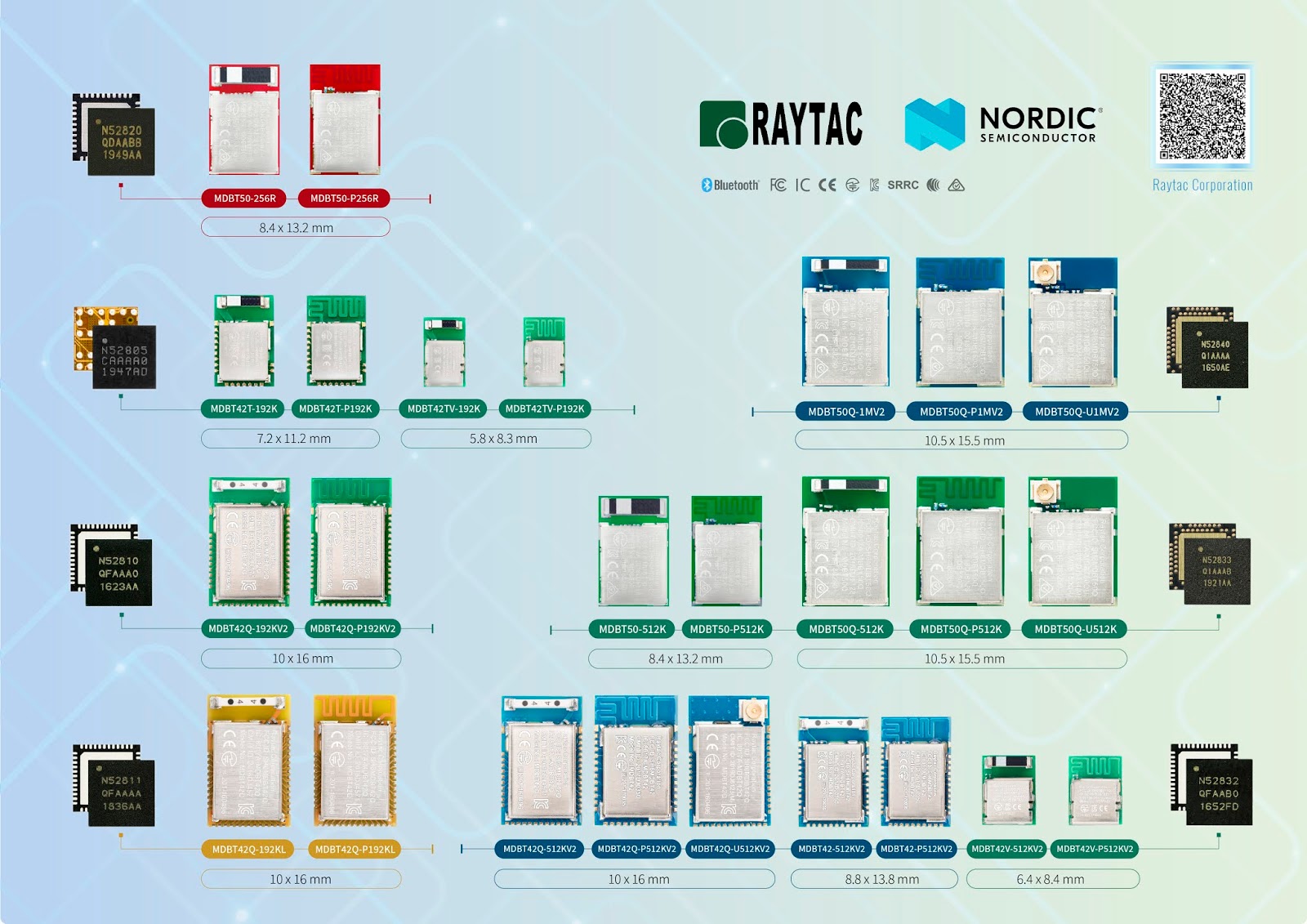
Raytac nRF52 Module Family in 2020

Nordic offers 7 nRF52 SoCs, but Raytac turns out 25 Modules!


Among nRF52 SoC family, Nordic offer 7 members cover from high-end multiprotocol functionality through baseline solutions. From this 7, Raytac extended to 25 modules offer a broad selections in a range of different form factors and antennas. 
All the nRF52 series modules from Raytac are Bluetooth qualified, FCC/IC/CE/Telec/KC/SRRC/NCC/RCM pre-certified. 

Find the module that fits your project among all 25 in www.raytac.com


Raytac Corporation 勁達國際電子有限公司
A BT5.2 & BT5.1 & BT5 module maker based on Nordic nRF52 & nRF51 solution 
(nRF5340 & nRF52840 & nRF52833 & nRF52832 & nRF52820 & nRF52811 & nRF52810 & nRF52805 & nRF51822)
www.raytac.comemail: cs@raytac.comTel: +886.2.3234.0208


Wednesday, May 22, 2019

Regulations, Certifications and Raytac's Modules - What do we make more convenient for our customers?

Raytac's pre-certified module for your convenience - but how?

So, in this post, we would like to take you on a little journey through most of the important certifications that Raytac has pre-certified their modules with.
The exact topic is actually what you need to know and what that means to you as a Raytac customer.


Obviously, each and every certification has their own rules, so that's how we're going to do this - one by one.

  1. FCC - (U.S.A.)
Most people in the industry have heard of FCC, but for you who really don't know what it is, it's the Federal Communications Commission in the United States of America. Although considered as a center for these regulations, you will soon realize that they're not really the center of these regulations and laws at all.
So for the FCC certification, you can as a Raytac customer:
  1. Use Raytac's certification ID directly on your finished product's label
  2. But you need to:
  3. Test FCC Part 15B EMC for your finished products

  1. IC - (Canada)
When it comes to the Industry Canada (yes, that's what IC stands for), the regulations and procedures are much like their sibling FCC.
  1. Use Raytac's certification ID on your finished product's label (same as FCC)
  2. But, just like FCC, you need to:
  3. Test IC ES003 (EMC)
    • This can be combined together with the FCC Part 15B test

  1. TELEC - (Japan)
TELEC, sometimes referred to as MIC, is surprisingly simple.
What you will need to do is:
  1. Use Raytac's certification ID on your finished product's label
Yes - you can actually just go right ahead and implement and/or commercialize your product after its parts are all proven TELEC certified which is pretty neat. However, there is another test that you as a customer can do if you wish, and that is VCCI which is just like the EMC tests mentioned above with the only difference (in terms of regulation) is that it's NOT mandatory. Thus, you can choose not to do it as well.

  1. KC - (South Korea)
As for the Korean regulation, these are the things you will have to do:
  1. Test EMC for wireless (KN301489 - same as CE's EN301489)
  2. Test EMC for wire (IO port) (KN3235)
    • If, and only if, your final product is equipped with IO ports, that is.
These two tests needs to be done locally (Korean test lab) and depending on which test it is, you'll have to deal with them differently.
Firstly, for the wireless test, you can refer to Raytac's own certification report so that the lab knows the module itself has passed although it still needs to be tested.
Secondly, the for wire (IO port) test, you will have to do from scratch essentially.
Thus, even though we have applied for KC for our modules, you will still have to test them locally.

  1. CE (Radio Equipment Directive 2014/53/EU (RED)) - (EEA, Europe)
Although CE is considered as strict regulation, the procedure is pretty simple. Simply put, you will have to conduct tests on a few different samples, and the procedure goes:
  1. Test on Conducted engineering sample (EN300328)
    • You can refer to Raytac's test report, if the test lab accepts it, that is.
      To ensure that they do, you can choose to conduct your tests at the same lab as Raytac - SGS.
  2. Test on Radiated engineering sample (EN300328)
  3. Test EMC (EN301489)
  4. Test Safety (EN60950)
    • Subject to change to EN62368 in 2021

  1. SRRC
Simply put, you will have 2 scenarios:
  1. Your end product can either be defined as a "Home Appliances" or an "Office Utilities" product
    • Then you can simply refer Raytac's SRRC ID (module policy just like FCC/IC/TELEC)
  2. Your end product is neither of the above
    • You have to apply for your own SRRC ID by testing everything required by the regulation

  1. NCC
They go by a "Platform policy" which basically means that as long as you are just adding functionality onto an already existing feature, then you can leverage Raytac's NCC ID on your product's label directly (module policy just like FCC/IC/TELEC/SRRC). Otherwise, you will have to apply for a new one.
Thus, the procedure becomes:
  1. Adding functionality of an already existing feature (a.k.a. platform)?
    • Then you can simply refer Raytac's NCC ID on your product (module policy just like FCC/IC/TELEC/SRRC)
  2. New ideas/features?
    • Sorry, you have to apply for your own NCC ID by conducting all tests necessary

  1. RCM
Australia's RCM (Regulatory Compliance Mark) is a lot like CE, much like IC is similar to FCC.
When applying to this certification, you will be in either of these two circumstances:
  1. CE already done.
    • You can refer to your own CE certification and ask your test lab to copy the report to your RCM application.
  2. CE NOT done.
    • You must conduct the test from scratch. But it is a whole lot like CE, meaning:
    • Test on Conducted engineering sample
    • Test on Radiated engineering sample
    • Test EMC
    • Test Safety
  1. Bluetooth Certification
Last, but definitely not least, is the Bluetooth Certification. For this one, choosing Raytac's modules will bring you great benefits. But first, you need to:
  1. Apply for Bluetooth SIG's "Adopter Membership" (free)
    • You can apply for the membership here
  2. Purchase your DID
  3. Leverage Raytac's QDID
    • To activate your newly purchased DID
For your first product, that is all you will have to do. But what if you come up with a new model of the product? Before you ask, I will answer "No - you don't necessarily have to purchase another DID." In order for this to be true though, your new product cannot have either of these things changed:
  1. Hardware
    • Unless you are still using Raytac's module
  2. Feature
    • Unless you are still using Raytac's module
  3. Brand Name
    • Brand name remains unchanged.
Although you might be able to apply for these certifications all on your own without trouble whatsoever, we always encourage customers using Raytac's BLE modules to contact us before hand so that we can provide you valuable information. This way, you will get unbiased guidance which will save you time and money.
As always - Happy tinkering everybody :)
Raytac Corporation 勁達國際電子有限公司 A BT 5.1 & BT 5 & BT 4.2 module maker based on Nordic nRF51 & nRF52 solution (nRF52840 & nRF52832 & nRF52811 & nRF52810 & nRF51822)
www.raytac.com email: cs@raytac.com Tel: +886.2.3234.0208

Tuesday, September 18, 2018

Nordic nRF52840方案模組 (勁達P/N: MDBT50Q) 完成藍牙與地區性安規認證


勁達國際電子秉持著"易用“政策 EE Policy (Easy Employ)開發一系列的藍牙模組希望能提供給所有客戶或開發者一個方便應用且快速市場反應的方案!為了讓易用政策能給客戶帶來最大的利益,勁達國際電子所生產的模組皆完成藍牙規範與地區性安規的認證. 因此, 使用勁達所生產的模組所製成的成品除能有效節省安規檢測費用外, 更能大量縮短申請檢測時的耗時費力工作.


Monday, September 17, 2018

nRF52840 Module MDBT50Q Series Bluetooth & RF Safety Certification Granted

Following Raytac's Easy Employ Policy (EE), we are glad to announce that Raytac's nRF52840 modules, MDBT50Q series have completed not only Bluetooth BQB certified, but also most popular countries's safety regulation granted.
With the effort to provide a most coverage of the regulation compliance, developers who build up the IoT project by Raytac modules can be easier to develop without worry for product testing and manage the budget of development.


Wednesday, July 4, 2018

Raytac BT5 MDBT50Q-U External Antenna Type Module (Nordic nRF52840 Solution) Now Is Available

Bluetooth 5 grabs the attention may drop in "Long Range Feature"!

Compare to BT4.X BLE module in the market, mostly reach only about 20~30M.
Even Raytac's BT4.X series modules, the best performance may about 100~140M line of sight.

Recent released MDBT50Q series, deploy Nordic nRF52840 has dramatically break the barrier of connectivity rage.
Upon the test under 1M bps  / sending data and link maintain, the connectivity range has reached over 340M


Thursday, October 12, 2017

nRF52832 BLE Module (P/N: MDBT42V) Safety Regulation Granted

Raytac's conducting Easy Employ Policy (EE), all Raytac's modules need to have not only Bluetooth BQB Certification, but also complied with most popular countries's safety regulation.
With the effort to provide a most coverage of the regulation compliance, developers who build up the IoT project by Raytac modules can be easier to develop without worry for product testing and manage the budget of development.

Friday, December 30, 2016

nRF52 BLE Module (MDBT42 series) BQB Test & BT4.2 Certification Granted

Raytac Corporation 

Bluetooth module maker based on Nordic nRF51 & nRF52 solution 
(Nordic nRF51822 & nRF51422 & nRF52832 & nRF52840)
Bluetooth Specification Version: BT4.0 & BT4.1 & BT4.2 & BT5
Tel: +886.2.3234.0208
email: service@raytac.com
We are pleased to release that Raytac's MDBT42 series module (including MDBT42Q / MDBT42 / MDBT42V) based on Nordic nRF52 series solution has completed the BQB testing and BT4.2 certificated granted.

Customers are welcome to use or relabel the QDID accordingly.

MDBT42 Module QDID: 91882 (Declaration ID: D033661)
MDBT42 Profile Subsystem QDID: 91659 (Declaration ID: D033662)


Wednesday, October 26, 2016

Raytac's nRF51 Module (MDBT40/MDBT40-P) Bluetooth QDID information


Raytac Corporation
Bluetooth module maker based on Nordic nRF51 & nRF52 solution 
((Nordic nRF51822 & nRF51422 & nRF52832)
Bluetooth Specification Version: BT4.0 & BT4.1 & BT4.2
Tel: +886.2.3234.0208
email: service@raytac.com  

Bluetooth products must purchase DID and submit the testing evidence issued by BQE to completed the SIG registration and activate the DID


Only products's DID been activated then allowed to use Bluetooth logo.

Developer's who built the products based on Raytac module is allow to relable Raytac's DID to easy the process.

Simply purchase their own DID from SIG, and relabel Raytac's DID then can completethe Bluetooth activation process.


Raytac's MDBT40/MDBT40-P QDID/DID is applied by subsidiary of Ginstar Corporation.
The QDID is 60912 / D023258

We welcome all Raytac's customers to relabel the QDID as long as product built by MDBT40/MDBT40-P. As such, the Bluetooth process becomes simple and cost effective.


Friday, June 17, 2016

Steps to Qualify Your Bluetooth Products

Raytac Corporation
A BT4.1 & BT4.2 module maker based on Nordic nRF51 & nRF52 solution 
(nRF51822 & nRF51422 & nRF52832 & nRF51802)
Tel: +886.2.3234.0208
email: service@raytac.com  
 https://raytacblog.wordpress.com/


To qualify a Bluetooth product always the issue make people headache.
Here, we summarized the procedure become simple steps to help readers to easy to follow

From Step 3~5, we are sincerely suggest readers to entrust BQB (Bluetooth Qualify Body) to provide the professional service to save time and energy according to our experience.

STEP 1 Become a membership


Adopter Membership: Free--> "Most customers pick"
Associated Membership: US$7,500 or US$35,000 (depends on company size)

For more detail of the benefit between different membership, please visit the link as below


STEP 2. Obtain Production Information from supplier or manufacturer

Make sure your chip supplier or module manufacturer has well certified or not.
All information can be refer to SIG's QDID information in public.
Makes sure the supplier or manufacturers' QDID has well certified including both Hardware and Profile QDID

STEP 2-1. Qualify Your Products


a. Customers can log in SIG's website to create a project in Test Plan Generator.
b. Pick up the type of qualification, such as End Product/Subsystem/Component/Development tool/Test equipment...etc.)
c. Link Layer, Spec, Profile 


STEP 3. Purchase the Declaration ID (DID)

Readers can buy the DID from SIG's website directly.


STEP 4. Submit Qualification Document

The Qualification Documents must been signed by BQE (Bluetooth Qualify Engineer) by BQB

STEP 5. Create and Submit the qualification


STEP 6. Brand Your Bluetooth Product


Friday, May 17, 2013

BLE (BT4.0) 藍芽認證資料FAQs

Raytac Corporation 勁達國際電子有限公司
A BT5 & BT 4.2 & BTv4.1 module maker based on Nordic nRF51 & nRF52 solution 
(nRF51822 & nRF51422 & nRF52832 & nRF52810 & nRF52840)
www.raytac.com          email: cs@raytac.com          Tel: +886.2.3234.0208


2014/2/1 Update:
本規範部分內文已於2014/2/1變更, 詳請可參閱以下連結
http://raytaccorp.blogspot.tw/2014/01/bt40-40-201421.html


2018/11/19 Update:
藍牙規範修正-BT4.1/BT4.0/BT3.0/BT2.1/BT2.0將於2020/7/1廢除, 2019/1/28開始限制新申請, 詳請可參閱以下連結


Quoted from : http://www.hypertaiwan.com.tw/


Q:模組認證過的成品是否須要做RF Full test
A:若是使用已認證過的模組,請提供此模組的QD ID和RF test report.
不需重做RF Full test.但若此模組天線不內含或外接, 則會針對天線的部份抽測RF 4個test cases。
Profile測試為必要


Q:Listing Fee 是什麼樣的費用
A:任何project在通過測試後, listing在SIG網站上所需支付給SIG的Listing fee. Listing fee區分為兩種 :
USD10,000 – For Adopter Member of SIG
USD 5,000 – For Associate Member of SIG
Q:何謂BQB
A:BQB (Bluetooth Qualified Body). 我們一般統稱為藍芽認證
Q:QDID 是否須要印製在產品上
A:QDID必須要印製在產品,外包裝或者相關文件上。(三者擇一)
Q:SIG會員有分幾種
A:一般來說會員分三種,Promoter, Associate, Adopter
Promoter 意指當初創辦SIG 組織的會員(如: Ericsson,Microsoft Motorola…等等)。
Associate 意指繳交年費的會員。
Adopter 意指無付年費的會員。(即一般會員)
Q:Associate 年費如何計算
A:以公司整體年營業額為據,超過一億美金以上,年費為USD35,000。 未超過一億美金,年費為USD7,500。
Q:如何申請由Adopter更改為Associate
A:請與Bluetooth SIG member contact聯繫, 提出升級需求. SIG專員便會盡快與您聯繫並告知下一步驟.
點選Bluetooth SIG網頁下方標題Experience Membership Benefits內文中Member Relations, 即可直接以MAIL 方式與SIG聯繫
Q:為什麼已經付了listing fee卻查無QDID
A:通常匯款會需要1-2個工作天數, 若已匯款超過四天, 網路上仍查不到可用的QD ID.
請盡速與Bluetooth SIG contact window連絡, 或請所屬實驗室BQE幫忙作確認
Q:. 測試時間大約多久
A:一般測試時間為兩週, 視樣品測試情況而定
Q:報價需提供那些資料
A:產品名稱, 所使用的Component基本資料以及支援哪些 Profile
如果可以, 直接提供Product Spec.即可
Q:為什麼要測IOP這個Profile
A:只要認證產品為End product,都需依規定作IOP(Interoperability Profile)測試
Q:Listing fee 要什麼時候付錢
A:在listing 之前任何時間付款給SIG即可
Q:User manual會秀在SIG網站上嗎
A:不會, User manual僅供BQE審核
Q:請問如何準備測試樣本
A:RF : 請準備1-2個samples並接上SMA 頭, 或者 RF cable線
Profile : 請準備2-3 功能正常的完整樣品即可


值得一讀與分享的BT 4.0 (BLE)低功耗藍芽介紹

Raytac Corporation 勁達國際電子有限公司
A BT5 & BT 4.2 & BT 4.1 module maker based on Nordic nRF51 & nRF52 solution 
(nRF51822 & nRF51422 & nRF52832 & nRF52810 & nRF52840)
www.raytac.com          email: cs@raytac.com          Tel: +886.2.3234.0208


藍牙規範部分已於2014/2/1變更
詳請可參閱以下連結
http://raytaccorp.blogspot.tw/2014/01/bt40-40-201421.html

2018/11/19 Update:藍牙規範修正-BT4.1/BT4.0/BT3.0/BT2.1/BT2.0將於2020/7/1廢除, 2019/1/28開始限制新申請, 詳請可參閱以下連結


Quoted : http://www.technical-direct.com/tech/20101101-bluetooth.html

藍牙技術聯盟(Bluetooth Special Interest Group,SIG)於2010年6月底時推出了最新主打低功耗的4.0版本,並預計於同年底或2011年初將有相關產品上市。由於目前藍牙技術的市場接受範圍似乎仍停留在以2.1+EDR為主,究竟4.0新規格的出現是否會帶來什麼樣的改變,已成為眾所關注的焦點,本文僅就4.0的規格特色、應用方向以及整個近距離傳輸市場後續的發展重點進行介紹。
不可忽略的藍牙4.0規格特色—低功耗、高射頻與雙工模式
◎目前主流藍牙規格

藍牙4.0的核心技術規範包括了傳統藍牙技術(例如Bluetooth 2.1+EDR)、藍牙3.0高速技術(Bluetooth 3.0 + High Speed)與最新的藍牙低功耗技術(Bluetooth low energy)三類,而其中的低功耗技術便是4.0的最大優勢特色。藍牙低功耗技術宣稱能節省達近九成的電力,相當適合使用“鈕釦型電池”裝置的市場,因為該技術能使裝置在閒置時休眠、僅在需要傳輸檔案時才啟動藍牙功能,因此能有效的降低電力耗損,以有效延長這些裝置更換電池的時間,因此能應用於小型傳感器像是計步器、血糖記錄器的使用。
至於在過去一直不變的傳輸距離上,過往藍牙的傳輸距離大約為30英尺(10公尺左右),在藍牙4.0規格中的有效傳輸距離則可明顯提升至最高約200英尺(60公尺左右)。製造商可以自行根據產品屬性調整其射頻範圍,讓藍牙傳輸的應用範圍有效拉大。
值得一提的是,藍牙4.0中開發出所謂的單工與雙工模式(Single Mode & Dual Mode)。透過單工模式能經由簡易的裝置搜尋、可靠的單點對多點資料傳輸設計與更先進的省電技術與加密方式,達到以最低成本實現超低電耗連線傳輸的目的。而雙工模式的運作架構,等於是可以與不同的藍牙規格(例如2.1 + EDR或是3.0 + HS)相結合,使用者可根據需求切換高速或者是低耗電的運作方式。因此歸納來說,單工模式可應用在一些需長時間連結但非持續傳輸資料的裝置,而雙工模式則適合可能同時需要與不同類型產品(像是電腦或手機)進行傳輸的裝置。
也就是說,藍牙4.0的技術規範讓傳統藍牙技術、藍牙3.0高速技術與藍牙低功耗技術三者,不僅可以獨立存在、也可以共同運用。舉例來說,一台血壓感測器如使用雙工模式,便可運用藍牙低功耗技術持續記錄人體的血壓高低,但同時也可使用傳統藍牙技術將記錄下來的數據資料傳送到電腦或其他裝置上。
◎藍牙4.0的核心架構:圖左為藍牙基本設計架構、圖中央為結合低功耗的雙工模式、圖右為Wibree技術的設計架構。 

藍牙技術之市場現況
就市面上的主流藍牙規格來區分類型,分別是強調增強資料傳輸率的藍牙2.0或2.1+EDR、主打高傳輸速率的藍牙3.0+HS以及甫公布的新增低功耗技術的藍牙4.0。
儘管在2009年4月藍牙技術聯盟就已推出新版的藍牙3.0規格並主打高速度傳輸,事實上,市面上的產品仍以2.1+EDR版本為主流,包括消費者最常使用的藍牙產品像是耳機、手機或是電腦周邊指向裝置如鍵盤、滑鼠,幾乎都還是以2.1+EDR的規格為大宗,甚至是筆記型電腦也只有一些較高階機種為藍牙3.0+HS規格。以今年最熱門的平板電腦產品為例(參見附圖),即便是蘋果今年甫推出的iPad、DELL的首款平板電腦產品Streak、或是以生產黑莓機著稱的RIM即將要推出PlayBook,這些新概念產品,也仍採用藍牙2.1+EDR規格,只有Samsung的Galaxy Tab採用藍牙3.0+HS版本。
◎目前市面知名平板電腦產品之藍牙規格 
這樣的現象與其他標準規格一代一代汰舊換新、逐漸導入新規格的現象,似乎不太相同。原因究竟何在?市場一般認為,目前藍牙技術的應用多半落在消費者的個人小檔案傳輸,像是透過藍牙耳機收聽音樂接聽電話、或是透過藍牙滑鼠鍵盤使用電腦,這類的小型資料傳輸通常較不需要高速支援。此外,追求高速度的代價換來的是較高的成本與較多的電力耗損,在產品沒有相對的效能需求之下,對廠商而言這似乎不是一個最划算的選擇,再加上當相應的產品都依舊使用原本的規格時,單方面的升級也不見得是必要的作為。
藍牙4.0的發展方向--運動管理、醫療健康照護與家用自動化 
那麼接下來的藍牙4.0,是否能夠取而代之呢?從藍牙4.0規格包山包海的兼容性,看得出其野心勃勃的姿態,至於未來發展似乎目前我們還不得而知。事實上,藍牙4.0的低功耗技術,在設計之初,便主打醫療與健康監控等特殊市場,藍牙技術聯盟的執行董事Michael Foley於此一技術發表之初,便強調藍牙低功耗技術的產品應用將主要落在運動管理、醫療健康照護與家用自動化(sports& fitness, healthcare, home automation)幾個面向上。
所謂的醫療市場為何適合這樣的應用呢?試想一下,在醫院有許多精密儀器的環境,經常會有禁止使用手機的規定出現,這是因為手機這類的電波頻率,極有可能造成電磁的干擾而影響醫療機器運作或是病患的休養,更遑論即使同樣是醫療儀器,像磁振造影機(Magnetic Resonance Imaging,MRI)這樣高電耗的設備,就有非常高的機會干擾到維生儀器的使用。因此,在醫院這樣需要監控病患病理狀態與生命跡象的環境,對低功耗的傳輸技術就有高度且必要的需求。
除了醫療單位這樣的場域,也可將藍牙低功耗技術的應用拓展到居家照護、健康監控與運動管理的範圍。在家中休養的病患可以使用藍牙技術的病徵感應器,來追蹤其健康狀況,家人也無須再亦步亦趨的時時提心吊膽;想記錄自己健身成效的運動者,也可在使用健身器材的過程中,透過個人的計步器、脈搏機或是健身器材上的顯示裝置,傳送並記錄個人的運動狀況到自己的藍牙裝置如手機或筆電中。
由英特爾發起、並由許多不同醫療技術與保健機構成立的Continua健康聯盟(Continua Health Alliance),日前便已決議將低功耗的藍牙4.0納入皆下來的標準傳輸技術。目前已有許多採用藍牙技術2.1+EDR規格的醫療產品像是血壓計、血壓監測螢幕、和計步器等,通過Continua健康聯盟的正式認證,接下來隨著新技術的導入,預期將有機會逐漸出現更多藍牙4.0規格的認證產品。
藍牙技術發展重點  聽測試專家怎麼說
面對藍牙4.0新技術規格的發展方向,目前於知名測試諮詢機構百佳泰測試實驗室擔任電腦產品測試中心主任之一,並為藍牙技術聯盟官方認可的BQE(Bluetooth Qualification Expert)高振家先生,有以下幾點獨到看法:

首先,是藍牙傳輸的穩定持續性,在低功耗的架構下是否能不受影響。我們都知道藍牙傳輸採用的是2.4GHz ISM頻段,與水的共振頻率相同、同時也有可能受到同頻段的其他傳輸技術所干擾。為避免這樣的狀況發生,藍牙使用調節性跳頻(Frequency Hopping),以每秒跳1600次的方式在80個頻道中轉換以減少干擾的可能性。不過在低功耗的狀態下,任何資訊的傳遞將會更容易受到同頻段其他物質或技術的影響,因此針對藍牙4.0的技術架構,更加需要透過詳細完整的驗證,來確認各個藍牙產品的穩定傳輸品質。
再者,是實際應用上的落實,是否能符合原先設計的目的性。藍牙4.0規格的一大特色便在於可以通過低功耗的技術,長時間以最低耗電模式運作,以記錄持續性的資料。然而,不能忽略的是,藍牙技術在傳輸數據資料時,至多只能與七個從屬裝置相串連,若是同時傳輸數據與音訊資料,則只能與兩個從屬裝置串連,這樣的狀況便會造成相當程度的應用限制。也因此,藍牙採用拓樸(Topology)的方式,將更多裝置彼此相連,使資料能在更多的裝置間相互傳輸,透過多對多的網狀拓樸(Mesh Topology)與一對多的星狀拓樸(Star Topology)使資料能彼此傳輸。不過值得注意的是,若是應用於醫療系統或健康監測上,不僅是要持續記錄病患病理變化,也極有可能出現緊急回報特殊狀況的情形,在這種情況下低功耗藍牙的拓樸是否能同樣有效即時地傳遞資料,絕對是實際應用上的重點。
最後,是產品製造商對於將產品導入藍牙4.0新規格的作業程序瞭解度。高振家先生因為本身為藍牙技術聯盟認可的BQE,經常會有廠商詢問關於”如何獲得藍牙認證”這樣的問題。面對這樣常見的狀況,高振家表示,其實藍牙技術聯盟官方制定的申請規範相當完整,但也因為規範內容的嚴謹細緻,以致於許多廠商經常會有一知半解的狀況。
◎藍牙產品標準認證測試流程
過去藍牙認證的方式是讓通過認證的產品取得一組QPID(Qualified Product ID),但這樣的作法會造成儘管內部設計架構沒有不同,只要是產品外觀改變或更換型號,就要重新申請認證。因此,為避免這樣不必要的時間與成本支出,藍牙技術聯盟新的作法則是讓所謂的”產品設計”取得一組QDID(Qualified Design ID),讓同樣的產品設計可以應用在不同產品上,也就是說,若是生產三款使用同樣藍牙設計的產品,則這三款產品皆歸屬於這一組QDID。同樣的,藍牙技術聯盟官網上的列表方式,也就由過去的QPL(Qualified Products List)改分為QDL(Qualified Design Listing)與EPL(End Product Listing)兩類,前者指的是通過驗證的產品設計,後者指的則是通過驗證的產品。如此一來,同樣的QDID廠商只需要負擔一次的listing fee,而消費者也更容易根據QDID選擇自己想要的產品。只是現實上,聯盟的規範與廠商的認知似乎還有一段落差,才會出現有產品未經官方認證就上市或是廠商多繳listing fee的狀況。
高振家也提到,藍牙技術在消費者生活中的普及已是不爭的事實,只是新規格要如何具體的導入、以及相關廠商是否會買單,則有待時間的證明。他所提到的三個關於實際驗證、應用落實與廠商採用的問題,只是就他身為BQE的經驗發現的幾個重點,至於實際上要如何讓藍牙規格持續被廣泛應用,勢必還有許多必須繼續發掘與關注的要素。
短距離/低功耗傳輸的競爭  藍牙技術何去何從?
就現況來看,在短距離的無線低功耗傳輸技術(ultra-low power short-range wireless technology)市場中,除了我們前面已多有著墨的藍牙4.0低功耗技術,Zigbee則是默默戮力耕耘的一項傳輸標準。
◎市面低功耗短距離傳輸規格
Zigbee與藍牙同樣被視為歸屬在個人區域網路 (Personal Area Network,PAN)的架構下,採用的是IEEE 802.15.4,工作頻率為868MHz、915MHz或2.4GHz,強調具有低成本、低耗電、雙向傳輸以及感應網路功能等特色,起初被定位於各種感測器的監控,目前則發展出多樣化的次標準,像是針對電源控制(Smart Energy Certified)、家庭自動化(Home Automation Certified)與電信服務(Telecom Service Certified)等認證規格,也積極拓展像是遙控及醫療電子等應用領域,目前已有上百樣產品獲得Zigbee的認證。Zigbee與現有藍牙技術的應用數量相比,似乎看起來又是小巫見大巫,儘管藍牙4.0的低功耗技術還需要時間發酵,不過依照眾家廠商對藍牙規格的愛戴程度,Zigbee勢必得要找出獨特的利基,才能更有異軍突起的機會。
除了現有低功耗技術規格Zigbee的苦心經營外,全球通訊晶片大廠高通(Qualcomm)也宣佈將於2011年推出名為”Peanuts”的低功耗傳輸技術,號稱將能以更低的耗電量與更大的傳輸速率,提供多樣化的應用方向,除了能應用在高通的最大市場—手機產品上,更可將技術發揮於安全監控或車載通訊等面向。此舉等於是對整個低功耗傳輸市場的宣戰,畢竟,高通掌握大量的晶片供應,根據產業界由上游影響下游的慣例,Peanuts的規格便極有可能出現在許多採用高通晶片的產品上。
若是再將範圍由低功耗傳輸技術拉大到整個近距離無線通訊(Near Field Communication,NFC),那麼即將出爐的Wi-Fi Direct則更被視為是藍牙的一大威脅。過去是藍牙由點對點(Peer-to-Peer)跨足到802.11協定轉換層,現在則是Wi-Fi Direct要回過頭來藉由點對點技術,吃下藍牙技術的大餅。透過Wi-Fi Direct,將可使各種像是手機、電腦、鍵盤、滑鼠、數位相機和印表機等產品直接以點對點方式傳輸資料,不需再透過另外的媒介或是藍牙所需的配對過程。
儘管規格未明,可以知道的是,Wi-Fi Direct能與所有現有的Wi-Fi 802.11a/b/g/n產品相容,廠商或消費者只要透過軟體的升級,便能直接具備Wi-Fi Direct的功能,不需要更換設備或元件;在安全性上,則支援支援WPA2加密傳輸標準;而至於傳輸速度方面,在產品本身支援802.11n的前提下,可達到最高250Mbps的速度。光是這樣的表現看起來已經相當驚人,更遑論目前市面上已有不計其數支援既有Wi-Fi規格的產品。
除了Wi-Fi Direct外,由日系大廠索尼(Sony)等十五家公司共同主推的TransferJet,結合了NFC與超寬頻技術(Ultra-Wide Band,UWB),主打短距離傳輸(傳輸距離設定為三公分)與超高速度(理論值可達560Mbps),可將較大容量的影像內容或音樂檔進行高速傳輸。再加上多家大廠如三星電子(Samsung)、東芝(Toshiba)、日立(Hitachi)、佳能(Canon)、尼康(Nikon)等的支持,勢必將在接下來的相機、電視、手機等相關消費性產品中佔有一席之地。由此看來,隨著Wi-Fi Direct與TrandfetJet的步步進逼,藍牙似乎還有一場硬戰要打。
知名國際研究機構Gartner於2010年3月發表出的2011年的十大主流行動技術中,其中一項便是藍牙,Gatner同時看好藍牙3.0與4.0的未來發展,主要原因在於,市場上將有更多產品需要較高的資料傳輸速度以滿足更大型的圖像或影片傳輸需求、而低功耗傳輸在醫療保健領域也將有相當的應用空間。儘管如此,考量到其他低功耗傳輸技術像是Zigbee與Peanuts的威脅、以及Wi-Fi Direct的來勢洶洶,實際的市場發展究竟會如何、是否各個規格皆能擁有一片天?則有待時間的證明,不過可以確定的是,這些技術規格的進步發展,若皆能有效應用於更多不同領域像是醫療協助、安全監控或是家庭自動化等,則更能讓我們生活中所存在的科技,更加便利、也更加符合人性。

Edied by Raytac Corporation (www.raytac.com)
BLE (BT4.0) by Nordic nRF51822 Chip